A Journey of an Architect to JE MADAM: Same Degree, Different Grid
I spent 5 years learning how to design buildings.
I mastered AutoCAD, made perfect 3D renders, and dreamed of my name on a fancy architecture firm.
Today, I wear a helmet, walk on muddy sites, and 50 people call me “JE Madam Ji”.
Welcome to my journey from Architect to JE Madam at UPPRD.
The First Day – That Look
My first day at the office, I walked in and I could feel it before anyone said anything. I was surrounded by people almost double my age, with 20 years of files in their hands and experience in their eyes.
And then that one common look – _“Is she capable?”_
No one said it loudly. It was just there, in a polite smile, in a slight pause before they handed me a file. I am a young woman, an Architect turned Consulting Engineer, in a department that has seen mostly men for years.
I didn’t argue; I just kept working. And slowly, that question in their eyes has started changing.
My First Site Visit – The Specially Abled Toilet
My first site was not a high-rise. Not a glass facade. Not a luxury apartment I used to design in my B.Arch studio.
It was the dimensions of a specially-abled toilet in a Panchayat.
A 2000 x 2000 mm room. On paper, it looks so small.
But when I stood there, on the dusty ground, with the mason waiting for my marking – I felt something I hadn’t felt in a long time. This small toilet is someone’s dignity. For a girl in a village school, for an old father, for someone in a wheelchair – this small room is their right to go to school, to live with respect.
In that moment, I was so happy with what I was doing. This is real. This is for the ground. This is architecture at its most honest.
And in the very next second, I missed it. I missed walking into a high-rise, the smell of fresh POP, the site with a tower crane, the lobby drawings. I missed being just an “Architect”.
The Architect Me
College was all about creativity.
Late nights in the studio. Coffee. Trace paper. Crits.
My professors said, “Design with soul.”
My dream was simple: design beautiful buildings and win awards.
The grid I lived in was clean, air-conditioned, and digital.
The Plot Twist
Then came Upprd.
Government job. Public service. Uttar Pradesh.
First day on site: No AC. No 3D model. Just a blueprint, 40°C heat, and 20 workers looking at me.
Someone shouted: “JE Madam aa gayi!”
That’s when I realized — I wasn’t here to just design. I was here to build.
Same Same But Different
As an Architect VS as JE Madam
Work in an AC office, while here you work under the sun
Client: 1 person Client, while here, client is an entire village
Deadline: “When it’s ready”; while here, the deadline is the Govt. tender date
Problem: “This wall color? while here Problem is Madam, inki naali ka paani humare ghar ke saamne se nahi jayega ?”
(English translation – “This wall color?” vs “Madam, their drain water shouldn’t flow in front of our house.” )
Tool: Laptop + Mouse, while here tools are cotton scarf + diary + pen + measuring tape
Same degree. Same passion for buildings.
But a completely different grid.
What I Learned
1. Communication > Design
A beautiful drawing means nothing if the mason doesn’t understand it.
2. You build people, not just buildings
An architect designs a house. A JE Madam helps a family get a home.
3. Respect hits different
Hearing “Madam ji, aap batao” from workers and elders… that pride is unmatched.
Closing Thought
The grid changed. The work changed. The challenges changed.
But the architect in me didn’t die. She just grew up.
Now I don’t just design structures. I help design futures.
From drawing lines on paper to drawing smiles on faces.
“Kuch din aise hi hote hain. Na kaam karne ka Mann, na rest karne ka.”
English translation: (Some days are like that . You have no desire to work, and no desire to rest either.)
“Kuch din aise hote hain jab laptop Kholo to band karne ka Mann kare. Aur band karo to lage kuch reh gaya. Ye beech wala din sabse mushkil hota hai…”
English translation: (Some days are like that. You open your laptop and want to close it right away. But when you close it, you feel like you forgot something. This middle day is the hardest one of all.)
Some days are not Monday, not Sunday, not productive, not even properly unproductive. They are just… lazy days.
You know those days? Let me tell you how my lazy days look.
1. Teamwork: Me, Myself and My Blanket
It’s 9 AM. My brain is saying, “Bro, please, 5 more minutes, just shut down.”
And my body is like, “No, we have to lie here and stare at the ceiling fan. This is important work.”
You are awake but you are not awake. You are sleeping, but you are not sleeping. You are in that weird middle zone where you are scrolling your phone with one eye open, the phone falls on your face twice, and you still don’t get up.
Your mind wants to go on a long vacation to deep sleep. Your body says, “We can’t sleep, but we can definitely not move.” So you both compromise – you stay in bed and do nothing. Perfect teamwork.
2. When the mind is racing at 200 kmph but the body has applied the emergency brake.
This is the advanced level of laziness.
Inside your head – 50 tabs are open. “I should clean the room.” “I should start going to the gym tomorrow.” “What if I learn BIM?” “I need to reply to that message from 3 days ago.” “My life is getting over.” “I should drink more water.”
Outside – one human is lying on the sofa like a dead Wi-Fi router. Not moving even an inch. Not even to pick up the remote which is just 2 inches away from the hand.
The mind is running a marathon. The body is on strike. And you are just stuck in the middle, watching this fight. The mind shouts, “GET UP!” The body replies, “Make me.”
So you don’t.
3. It’s like you are sitting on a sofa and the sofa says – “Let you sit the way you are, don’t disturb.”
On lazy days, the sofa becomes your best friend, your mother, your soul mate. It hugs you. It understands you.
You sit in the weirdest position – one leg on the armrest, one leg on the floor, neck tilted at 90 degrees, hair looking like a bird’s nest. And you think, “This is it. This is the most comfortable I have ever been in my entire life. If I move, this magic will break.”
So you don’t move. You become one with the sofa. People call you. You say, “I am busy.” Busy doing what? Busy sitting. It’s a full-time job.
The world can wait. The dishes can wait. The laundry can definitely wait. On lazy days, your motto is: If it doesn’t run away, it can wait.
4. And then everything starts talking to you.
This is my favorite part of lazy days. When you are doing nothing, you start noticing everything.
You spend 20 minutes talking to the clock. “You are ticking so fast, man. Why are you in a hurry? Relax. See, I am not in a hurry. You are just wasting time. Or am I wasting time? Are we both wasting each other’s time?”
Then you look at your dog and give him a full lecture for one hour: “Listen, Oreo, this is not done. You cannot do potty here and there. This is our house. We have rules. You are breaking the rules. Are you even listening to me?”
And Oreo looks at you like, “You are the one who has been sitting here for 4 hours talking to a wall, and you are calling ME weird?”
You talk to the plant – “Are you thirsty? You look sad today.” You talk to the fan – “You are making so much noise.” You talk to yourself – “Why am I like this?”
And honestly, it’s beautiful.
We live in a world that keeps shouting: Hustle! Be productive! Wake up at 5 AM! Do 10 things at once! Make your day count!
But lazy days remind you – you are a human, not a machine.
Sometimes your battery is not low, it’s just in power-saving mode. Your mind and body are not lazy; they are just tired of running. They need a day to do nothing, to not be judged, to just lie down and talk nonsense to a clock.
So if today is your lazy day, don’t feel guilty.
Don’t fight with your body. Let it sit. Let it be weird. Let it talk to the dog. Let it waste time. Because wasting time is sometimes the best way to find time for yourself.
Tomorrow you will get up. Tomorrow you will run again. But today?
Today, just be on the sofa. The way you are. Don’t disturb.
There are some classrooms where you learn a subject.
And then there are some classrooms that quietly change the way you see the world.
For me, architecture was the second kind.
When I look back at my early days of architecture school, I don’t remember only the sheets I drew, the lectures I attended, or the deadlines I somehow survived. I remember the little things—the drafting table, the parallel bar, the pencils, the bricks, the endless lines, the discussions, the mistakes.
At that time, many of those things seemed unnecessarily complicated.
Today, I realise they were quietly preparing me for much more than architecture.
They were shaping me.
The First Battle: Setting Up the Drafting Table
My first class didn’t really begin with architecture.
It began with figuring out how on earth to set up a drafting table.
We had the drafting board, the thread, the parallel bar, the set square and, of course, the bag pack that seemed to contain everything except the thing we actually needed.
The biggest confusion was figuring out how to fix the thread and the pulley system properly.
There were different ways to do it—metal clamps, plastic stiffeners and several other methods that seemed perfectly reasonable at first.
But there was one little thing I discovered later that turned out to be the real one-man army:
The metal nail.
Yes, that tiny nail—the same kind carpenters use.
It held the parallel-bar thread pulley firmly. The other methods worked too, but they could loosen, shift or get disturbed quite easily.
That first day was messy.
Threads everywhere.
Confusion everywhere.
Everyone trying to figure out which method was actually the right one.
But much later, I realised something.
Setting up that drafting table was like preparing the ground before hitting a six in a cricket match.
You cannot simply walk onto the field and expect to hit the perfect shot.
First, you prepare.
You position yourself.
You make sure your equipment is ready.
Then you play.
Architecture was teaching me that lesson before I even knew I was learning it.
The Sheet That Refused to Behave
Once the drafting tables were finally ready, another challenge arrived:
Fix the drafting sheet.
Sounds easy, right?
Just put the sheet on the board and secure it with cellotape.
But apparently, even that had an art to it.
The sheet had to be perfectly aligned and square.
Use too much glue and the corners would tear.
Use too little and the sheet would refuse to stay.
And if you didn’t fix it properly, the sheet would eventually start moving along with the parallel bar.
At that time, I thought:
“Why is something this simple becoming such a big task?”
But later I understood.
Before you can create something beautiful, you have to gear up your base properly.
The foundation may not be visible in the final product, but it determines how well everything else works.
That lesson stayed with me.
And then, finally, the lectures began.
I was nervous.
But I was excited too.
I had no idea that those ordinary-looking classes were going to change me.
The ₹40 Pencil
One of my first design classes was with Ar. Kuldeep, our design faculty at the time.
He suggested that we use a Staedtler pencil.
One pencil.
₹40.
That was a lot for a pencil back then.
My immediate reaction was basically:
“Seriously?”
But the pencil was only the beginning.
He taught us how to sharpen it properly.
And when I say properly, I mean properly.
We spent what felt like hours working with a snap-off blade to create the perfect grip and using iron paper to achieve that precise pencil point.
I remember wondering:
“What is the point of spending so much time preparing a pencil when we could just start drawing?”
Years later, I understood.
The lesson wasn’t really about the pencil.
It was about preparation.
Before creating a presentable sheet, you prepare your tools.
You prepare your mind.
You prepare your workspace.
You prepare yourself.
Because once you learn how to gear up your tools before entering the battle, half the battle is already won.
And the Staedtler itself taught another small lesson.
Don’t always fall for the cheapest option.
Good tools matter.
A sturdy pencil with quality graphite may cost a little more, but it performs differently.
Sometimes, investing in the right tool is not an expense.
It is preparation.
H1, H2, HB, B1, B2…
Then came another lecture.
We had to draw lines.
Different pencils.
Different grades.
H1.
H2.
HB.
B1.
B2.
And probably several others that made me question everything I thought I knew about pencils.
I had previously been perfectly comfortable with my basic Natraj pencil.
And suddenly architecture had introduced me to an entire family of pencils.
The task was simple:
Draw seamless lines using different grades.
In reality?
It was frustrating.
The pencil points broke.
The sheet moved.
The lines didn’t look right.
Sometimes the pencil felt completely wrong in my hand.
I hated the exercise.
But I eventually understood what it was trying to teach me.
If you keep using only the tools that are comfortable for you, you will keep producing the results that those tools allow.
If you want different results, you have to learn to command different tools.
That lesson has nothing to do with pencils alone.
It applies to life.
Different problems require different approaches.
Different situations require different skills.
And sometimes the tool that feels uncomfortable is exactly the tool you need.
The Brick That Taught Me About Big Things
Then came our first construction lecture.
Bricks.
I remember thinking:
“Bricks? Really?”
I had played with them in my childhood while making tiny houses for my toys.
I never imagined that such a simple rectangular block could be so important in architecture.
But that day changed my perspective.
A building that looks enormous from the outside is ultimately made from countless smaller units.
One brick.
Then another.
Then another.
And another.
Until thousands of small pieces become something big.
That day I learned something I still carry with me:
Every big thing is a result of repetitive small things.
So focus on the small.
Because the small things are what eventually build the big things.
A building.
A career.
A relationship.
A life.
The Art of Making Things Better
Our Art and Graphics classes were taught by Mr. Anil Vishwakarma.
He was exceptionally good at what he did.
But what I remember most wasn’t just his teaching technique.
It was the way he looked at our drawings.
We could bring him something that we thought was completely ruined.
A drawing full of mistakes.
Something we weren’t proud of.
And somehow, he would work with it.
He wouldn’t necessarily make it perfect.
But he could always make it better than before.
And that stayed with me.
Because perhaps that is how life should work too.
We don’t always get the chance to start with a perfect drawing.
Sometimes we make mistakes.
Sometimes we take the wrong line.
Sometimes the proportions are completely off.
Sometimes we look at what we have created and think it is beyond repair.
But maybe it isn’t.
Maybe we just need to work on it again.
Correct a little.
Improve a little.
Learn a little.
Try again.
Every point in life can become a new beginning.
You don’t always have to erase everything.
Sometimes you simply need to make what you already have a little better.
Architecture Wasn’t About Memorising
One of the things I loved about architecture school was that many of our lectures didn’t feel like traditional lectures.
It wasn’t always:
Teacher sitting on a chair.
Students sitting silently.
Someone dictating information.
Everyone trying to memorise it before the examination.
Instead, many classes felt like conversations.
Discussions.
Debates.
Questions.
One-to-one conversations.
Arguments about ideas.
Sharing perspectives.
Listening to someone else’s interpretation.
It was very different from school life.
And surprisingly, I liked it much more.
Because when you discuss something, you don’t simply remember it.
You begin to understand it.
When you explain your thoughts, you discover what you actually think.
When someone challenges your idea, you learn to defend it—or sometimes realise that you were wrong.
Architecture slowly taught me that learning isn’t always about collecting answers.
Sometimes it is about learning how to ask better questions.
And Then Architecture Started Changing Me
These are only a few memories from the early stages of architecture.
A drafting table.
A metal nail.
A sheet of paper.
A ₹40 pencil.
Different grades of graphite.
Endless lines.
Bricks.
Drawings.
Discussions.
Teachers.
Mistakes.
At the time, they seemed like disconnected parts of an architecture curriculum.
Today, I see the connection.
They were all quietly building something inside me.
Architecture taught me to prepare before beginning.
To respect my tools.
To step outside my comfort zone.
To understand that big things are made from small, repetitive efforts.
To improve instead of giving up.
To discuss instead of simply memorising.
And most importantly, architecture taught me to observe.
Since then, the chain has never really stopped.
I learned something from every drawing.
Every building.
Every site.
Every mistake.
Every teacher.
Every project.
Every deadline.
And slowly, without even realising it, the way I looked at the world began to change.
A normal door stopped being just a door.
It became an opening.
A red wall stopped being just a red wall.
I started noticing the brickwork.
The bond.
The texture.
The pattern.
The way light touched its surface.
A staircase wasn’t simply something to climb.
It became a study of movement, proportion and space.
Windows became frames.
Shadows became compositions.
Empty spaces became meaningful.
And somewhere along the way, something else changed too.
I started paying attention not only to the minute details of architecture…
but also to the minute details of life.
The small things people say.
The pauses between conversations.
The way a place makes you feel.
The details everyone else might walk past.
The little things that eventually become something much bigger.
This Is How Architecture Shaped Me
When I think about architecture today, I don’t think it only gave me a profession.
It gave me a perspective.
It changed the way I observe.
The way I think.
The way I solve problems.
The way I understand mistakes.
The way I approach preparation.
The way I appreciate details.
Architecture didn’t just teach me how to design spaces.
It taught me how to see them.
And perhaps, in the process, it taught me how to see life a little differently too.
Those early days were not simply about learning how to draw a line, fix a sheet, sharpen a pencil or understand a brick.
They were about learning how to build myself.
One small lesson at a time.
One mistake at a time.
One drawing at a time.
One conversation at a time.
And just like a building, the person I am today wasn’t created in a single day.
It was built layer by layer.
Frame by frame.
Detail by detail.
This is how architecture framed the Shubham Mishra I know today.
And perhaps that is the most beautiful thing architecture gave me.
हर साल 15 अगस्त आता है। तिरंगा लहराता है, लोग “जय हिंद” कहते हैं, सोशल मीडिया पर देशभक्ति से भरी पोस्टें होती हैं, स्कूलों में कार्यक्रम होते हैं, और हमें मिलती है… एक लंबी छुट्टी!
लेकिन क्या बस इतनी ही है आज़ादी?
क्या आज़ादी का मतलब सिर्फ एक दिन की छुट्टी, परेड और मिठाइयाँ हैं? या फिर ये उससे कहीं ज्यादा गहरी, बड़ी और जिम्मेदारी भरी चीज़ है?
आज़ादी हमें किसी ने थाली में परोसकर नहीं दी थी। ये वो अधिकार है जिसे अनगिनत लोगों ने अपने खून, पसीने, त्याग और बलिदान से हासिल किया था।
तो क्या हम इस दिन को सिर्फ एंजॉय करने के लिए मनाते हैं? या उन सपनों और कुर्बानियों को याद करने के लिए, जिनकी वजह से हम आज़ाद होकर जी पा रहे हैं?
शायद सवाल ये नहीं कि 15 अगस्त को हमें क्या करना चाहिए। सवाल ये है कि हम 16 अगस्त से 14 अगस्त तक क्या करते हैं।
आज़ादी का असली जश्न सिर्फ एक दिन नहीं, हर दिन हमारे सोचने, बोलने और जीने के तरीके में दिखना चाहिए।
आज इसको लिखने का विशेष उद्देश्य है, आज के देखते हालात और लोगों का इस दिन के प्रति जो नजरिया है उसे देखते हुए दुःख होता है । इसी के चलते मैं आज आप लोगों के साथ, बचपन में पढ़ी गई कहानी साझा करती हूं । ये कहानी मुझे पता नहीं क्यों हमेशा याद रहती है कारण शायद ये था की ये चैप्टर बहुत लंबा था और मेरा खुद इसको पढ़ने में मन न लग रहा था, शायद कारण मेरा इतिहास में रुचि न रखना था । लेकिन इस कहानी का अंत ऐसा था जिसने मुझे सोचने पर मजबूर कर दिया और मुझे आज तक उस किताब की शायद ये अकेली कहानी ही है जो याद है |
कहानी कुछ इस प्रकार थी —कहानी थी दूसरे विश्व युद्ध के समय की जब नाज़ी ने फ्रांस को अपने कब्जे में लिया था । एक ऐसे बच्चे की, जिसे फ्रेंच भाषा सीखने में बिल्कुल रुचि नहीं थी। उसे फ्रेंच के पाठ उबाऊ लगते थे। स्कूल जाना, व्याकरण पढ़ना और अपनी भाषा के नियम याद करना उसे किसी बोझ से कम नहीं लगता था। उसे लगता था कि इन चीज़ों से आखिर उसकी ज़िंदगी में क्या बदलने वाला है?
लेकिन एक दिन सब कुछ बदल गया।
उसका देश जर्मनी के कब्ज़े में चला गया। आदेश आया कि अब स्कूलों में फ्रेंच नहीं पढ़ाई जाएगी, बल्कि जर्मन भाषा पढ़ाई जाएगी। अचानक वही फ्रेंच भाषा, जिसे वह बच्चा कल तक नापसंद करता था, उसके लिए बहुत मूल्यवान हो गई। उसे पहली बार एहसास हुआ कि वह केवल एक भाषा नहीं थी। उसमें उसकी पहचान थी, उसकी मिट्टी की खुशबू थी, उसके लोगों की आवाज़ थी और सबसे बढ़कर—उसकी स्वतंत्रता का एक हिस्सा था।
शायद हमारे साथ भी कुछ ऐसा ही होता है।
आज हम अपने देश में स्वतंत्र होकर सांस लेते हैं। हम अपनी भाषा बोल सकते हैं, अपनी संस्कृति को जी सकते हैं, अपनी पसंद के कपड़े पहन सकते हैं, अपने विचार व्यक्त कर सकते हैं और अपने देश के भविष्य को लेकर अपनी राय रख सकते हैं। लेकिन क्या हम हमेशा इस स्वतंत्रता की कीमत को महसूस करते हैं?
शायद नहीं।
क्योंकि जो चीज़ हमें आसानी से उपलब्ध होती है, उसकी कीमत अक्सर हमें तब समझ आती है जब उसके छिन जाने का डर सामने खड़ा हो।
भारत की स्वतंत्रता हमें उपहार में नहीं मिली थी।
“आज़ादी कोई उपहार नहीं थी, जो हमें थाली में परोसकर दे दी गई हो।यह वह अधिकार था जिसे हमारे वीरों ने अपने साहस, संघर्ष और बलिदान से हासिल किया था।”
यह उन लोगों के साहस, संघर्ष, त्याग और बलिदान का परिणाम थी, जिन्होंने यह स्वीकार करने से इनकार कर दिया कि कोई दूसरा हमारे ही देश में हम पर शासन करे। कितने ही लोगों ने अपना घर छोड़ा, कितनों ने जेलें देखीं, कितनों ने यातनाएँ सहीं और कितनों ने अपने प्राण तक न्योछावर कर दिए—सिर्फ इसलिए कि आने वाली पीढ़ियाँ अपने देश में आज़ाद होकर जी सकें।
आज हमारी जिम्मेदारी केवल इतना नहीं है कि स्वतंत्रता दिवस पर तिरंगा फहरा दें, राष्ट्रगान गा लें और कुछ देशभक्ति के संदेश साझा कर दें।
हमारी असली जिम्मेदारी है—इस देश के प्रति वफादार रहना।
राजनीतिक दल आएंगे और जाएंगे। सरकारें बदलेंगी। नेता बदलेंगे। विचारधाराएँ बदलेंगी। हमारी राजनीतिक पसंद अलग-अलग हो सकती है और हमारे विचारों में मतभेद भी हो सकते हैं। यह लोकतंत्र की खूबसूरती है।
लेकिन इन मतभेदों के बीच हमें एक बात कभी नहीं भूलनी चाहिए—
हमारी पहली पहचान किसी राजनीतिक दल के समर्थक की नहीं, बल्कि इस देश के नागरिक की है।
हम किसी पार्टी से असहमत हो सकते हैं, लेकिन अपने देश से नहीं। हम किसी नेता की आलोचना कर सकते हैं, लेकिन अपने देश और अपने देशवासियों के प्रति सम्मान नहीं खोना चाहिए।
क्योंकि अंत में पार्टी नहीं बचेगी, सरकार नहीं बचेगी, पद नहीं बचेगा—बचेगा तो सिर्फ देश और उसके लोग।
हमारी भाषा अलग हो सकती है। हमारी संस्कृति अलग हो सकती है। हमारे विचार अलग हो सकते हैं। हमारी पसंद और प्राथमिकताएँ अलग हो सकती हैं। लेकिन इन सबके ऊपर एक चीज़ हमें जोड़ती है—हम भारत के लोग हैं।
इस स्वतंत्रता दिवस पर शायद हमें केवल यह याद करने की जरूरत नहीं कि हमें आज़ादी कैसे मिली थी, बल्कि यह भी याद करने की जरूरत है कि हमें इस आज़ादी को कैसे संभालकर रखना है।
आज कल एक नया ट्रेंड है, की चार लोग इकट्ठे होकर देश के प्रति कार्य कर रहे लोगों की आलोचना करेंगे , लेकिन हमें कभी कभी ये सोचना चाहिए कि कभी कभी जिस उम्र पर बैठकर हम हमारे वीर शहीदों की आलोचना कर रहे होते हैं, न जाने कितने ही उस उम्र के पायदान तक कभी न जा पाए हमारी सुरक्षा के कारण ।
आइए, अपने मतभेद रखें, अपने विचार रखें, सवाल पूछें, असहमति रखें—लेकिन एक-दूसरे के प्रति सम्मान और अपने देश के प्रति निष्ठा बनाए रखें।
क्योंकि जिस आज़ादी के लिए किसी ने अपना आज कुर्बान किया था, उसे हमारी छोटी-छोटी राजनीतिक और सामाजिक दूरियों के कारण कमजोर नहीं होना चाहिए।
देश किसी पार्टी से बड़ा है। देश किसी नेता से बड़ा है। देश हमारे व्यक्तिगत मतभेदों से बड़ा है।
और शायद यही स्वतंत्रता दिवस हमें सबसे बड़ी बात सिखाता है—
स्वतंत्रता की कीमत उसे खोने के बाद नहीं, उसे जीते हुए समझनी चाहिए।
आइए, इस स्वतंत्रता दिवस पर एक संकल्प लें—
मत अलग हो सकते हैं, दिल नहीं। विचार अलग हो सकते हैं, देश नहीं। पार्टी अलग हो सकती है, भारत नहीं।
I was beginning a journey as an architecture student at MET, Moradabad.
And honestly, I was terrified.
I had chosen architecture against my father’s wish. But the funny thing about my father was that, even when he disagreed with us, he never forced us to live the life he had imagined for us. He gave us the freedom to choose.
He was, in many ways, way ahead of his time—especially for the place we came from, Powayan. Things have changed a lot there now, but back then, his way of thinking felt different.
And so, on that August morning, I left home carrying a strange mixture of excitement, fear, guilt, and a heart that was already beginning to miss everything I was leaving behind.
THE JOURNEY
After travelling all the way from my hometown, Powayan, to Moradabad, we finally reached the college.
I remember the entrance vividly.
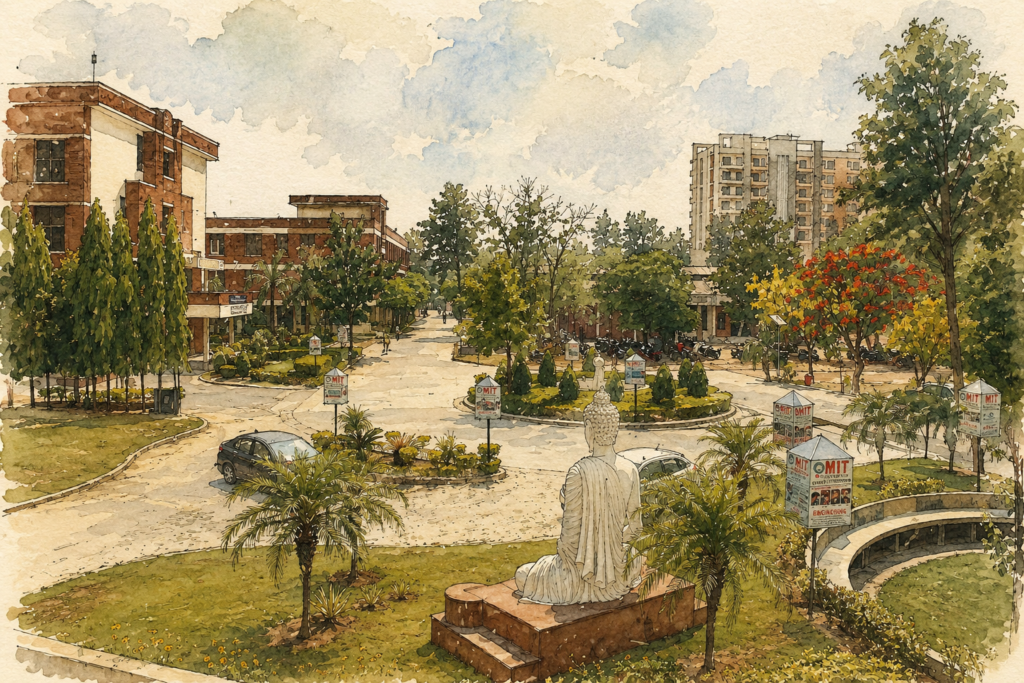
There was a brown gate on the right-hand side. Beyond it was a landscape that, to my eyes, looked completely unfamiliar—maroon buildings, green trees, grey roads, and a few buildings painted light yellow.
There was a small, hut-shaped entry house where entries were being recorded.
My father stopped and asked the guard,
“Architecture Department kidhar hai?”
(English Translation – “Where is the Architecture Department ? “)
The guard bhaiya simply raised his hand and pointed towards the building at the other end of the lane.
I looked in that direction.
That building suddenly felt enormous.
Like a monster waiting at the end of the road that was going to swallow me whole.
Gathering whatever courage I had, I walked inside with my father and completed all the admission formalities.
Then I asked someone about the hostel.
And we started walking towards it.
I remember wishing that the lane would somehow become longer.
Just a little longer.
Because somewhere inside me, I was still hoping that something would happen—that maybe the hostel stay would somehow get cancelled, and I could just go back home.
But life doesn’t usually negotiate with you.
The hostel gate appeared.
And then it happened.
The gate closed behind my father with that unmistakable “cheenk” sound.
I still remember it.
That sound felt louder than it actually was.
Like the sound of a chapter closing.
THE GATE THAT FELT LIKE GOODBYE
That gate felt like goodbye.
For the first time in my life, I was going to live away from home.
Alone.
With strangers.
A part of me was excited.
But the child inside me was screaming,
Please, don’t leave me here.
After my room was allotted, my father looked at my mother and said,
“Let’s go home.”
And the moment I heard those words, I started crying.
My mother started crying too.
And there we were—holding each other and crying at the hostel gate like two characters from an overdramatic Indian television serial who had finally found each other after being separated for twenty years.
People around us were actually laughing.
Maybe for them, it was funny.
Maybe it was completely normal.
For me, it was one of the hardest moments of my life.
I didn’t know how to stay away from home.
I didn’t know how to sleep without my family nearby.
I didn’t know how to be an adult.
And, of course, one of my seniors later mocked me for crying that day.
At that time, I remember thinking,
I swear, if I wasn’t a junior…
But I was.
So I survived that with everything else.
I entered my hostel room and went completely blank.
It was basically a cleverly designed 10′ × 10′ partition of a 2BHK flat.
I barely noticed anything.
The room.
The bed.
The walls.
The people.
Nothing registered.
I just cried.
A lot.
Because no one tells you how loud silence becomes on your first day away from home.
4:00 AM
That night—or perhaps that morning—I woke up at 4:00 AM.
I took a bath, got ready, and offered puja to Maa Saraswati, Sai Baba, and Mahadev.
I needed them that day.
And somehow, they stayed with me throughout that entire journey.
My breakfast timing was 8:00 AM.
There was a window in my room that opened towards the temple of Maa Saraswati.
I sat there.
And looked at the temple.
For hours.
The temple had an octagonal central space where the statue of Maa Saraswati stood. Around it was a small square peripheral boundary, with large glass openings through which I could see glimpses of the statue.
I don’t know what I was thinking.
Maybe nothing.
Maybe everything.
I just kept looking.
Three hours passed without me realizing it.
And suddenly, it was 8:00 AM.
Time for breakfast.
On my way to the mess, there was a small metal bridge connecting two buildings.
I crossed it, had breakfast, came back, got ready for college, and prepared myself for the most terrifying thing yet.
My first day.
I don’t remember what I wore.
I don’t remember what I ate.
But I remember exactly how I felt.
AND THEN IT WAS TIME—MY FIRST DAY AT COLLEGE
The classroom was full of people from different places.
Different faces.
Different energies.
Some looked excited:
“Let’s make friends!”
Some looked completely lost:
“What the hell am I doing here?”
Some already seemed to know everything:
“Bro, I already know everything.”
And some were simply enjoying the beginning of what they believed would be the best years of their lives.
And then there was me.
Sitting quietly inside the classroom, thinking:
“God, B.Tech se toh bach gayi… ab yahan se kaise bachun?”
(English Translation – ” I managed to escape B.Tech……. Now, how do I escape this?” )
I had no idea that the place I was desperately trying to escape from would eventually become one of the most important chapters of my life.
I had no idea that the strangers sitting around me would slowly become friends.
That the classrooms would become familiar.
That the hostel would eventually feel less like a prison and more like home.
And I certainly had no idea that this ordinary-looking day would become a memory I would carry for the rest of my life.
THE INTRODUCTION ROUND — AND THE THREE LADIES
Then three ladies walked into the classroom.
And honestly?
OMG.
They each had their own aura.
I loved it instantly.
Santosh Ma’am—the HOD of the department.
Uparika Ma’am.
And Gunjan Ma’am.
They sat on chairs in front of the entire class, at the podium.
The introduction session began.
My heartbeat?
Uncountable.
One by one, students went forward.
People talked about their talents.
Someone danced.
Someone sang.
Someone talked about drawing.
Some were genuinely amazing.
And then—
My name.
My heart almost stopped.
I got up and walked towards the front, holding my heart with both hands.
Santosh Ma’am looked at me and asked,
“Why did you opt for architecture?”
This time, I decided to be honest.
Because I had already understood one important thing about Santosh Ma’am.
You cannot lie to her.
She somehow knows.
So I said,
“I came here as an escape from B.Tech.”
And there it was.
My brutally honest introduction.
Then she asked,
“Tell us your hobby.”
Blank.
Absolutely blank.
My mind was suddenly like an A4 sheet with nothing drawn on it.
While listening to everyone else’s introductions, however, I had realized something about myself.
I was—and still am—a huge fan of stories and poems.
So I said,
“I like reading.”
And then, perhaps because I had already survived the hardest part, I even recited my favourite comic poem from that time.
I’ll share that poem with you guys someday.
It’s really amazing.
And then—
It was over.
I walked back to my seat.
My heartbeat slowly returned to normal.
But that tiny introduction stayed with me.
Even after all these years.
THE LANE BACK TO THE HOSTEL
After the introductions, we were free.
We could explore the college or go back to the hostel.
I chose the hostel.
And I walked back alone.
That same lane.
The one that had looked like a monster a few hours earlier.
Only now, I was walking through it by myself.
I felt as if everyone was looking at me.
Maybe nobody was.
But that’s how it felt.
I walked the entire lane lost in my own thoughts.
I didn’t know it then, but somewhere between that college building and that hostel gate, something had changed.
I was still scared.
Still homesick.
Still that girl who wanted her parents to turn around and come back.
But I had entered college.
I had introduced myself.
I had survived my first day.
And perhaps, without realizing it, I had taken my first real step towards becoming the person I would eventually be.
That evening, I met a few of my batch mates in the hostel.
And yes, these are all the people from my department who live in the hostel with me.
Prachi.
Priyanshi.
Ayushi.
Pooja.
Nazma.
Adeel.
Yusra.
Pranjali.
Vishakha.
Shristi.
At that moment, they were just names.
Just a bunch of strangers who happened to be in the same hostel, in the same batch, at the same time.
I had absolutely no idea that this was Day 1 of a five-year story we would eventually frame together.
A story made of fights.
Laughter.
Tears.
Assignments.
Secrets.
Late-night conversations.
Maggi at 2 AM.
Stupid jokes.
Celebrations.
And countless memories that would one day become impossible to explain to anyone who wasn’t there.
After dinner, I called my parents.
Hearing their voices made the strange new world feel a little less strange.
And then I went to sleep.
Scared.
Homesick.
Still missing home.
Still wondering how I was going to survive this place.
But somewhere between the tears, the unfamiliar room, the temple outside my window, the strange faces in my classroom, and that hostel gate that had closed behind my father…
Something had changed.
For the first time in my life, I was completely on my own.
And strangely…
For the first time, I was exactly where I was supposed to be.
I didn’t know it then, but I had already crossed the hardest door.
The door between being someone’s daughter at home…
And becoming a little more of myself.
And somewhere inside that strange new place, surrounded by unfamiliar faces, my five-year story had quietly begun.
If I could go back to that 13-year-old version of me—standing at that hostel gate, crying and desperately wanting to go home—I would just hug her and say,
“Don’t worry. You are going to be okay.”
“In fact, you are going to have the time of your life.”
Because that scared little girl had no idea how beautiful the story ahead of her was going to be.
Dear Readers, now I want to know about you.
What was your first day at college like?
Were you excited, scared, homesick, and completely lost—or already ready to conquer the world?
Tell me your first-day story. I’d love to know what that day looked like for you.
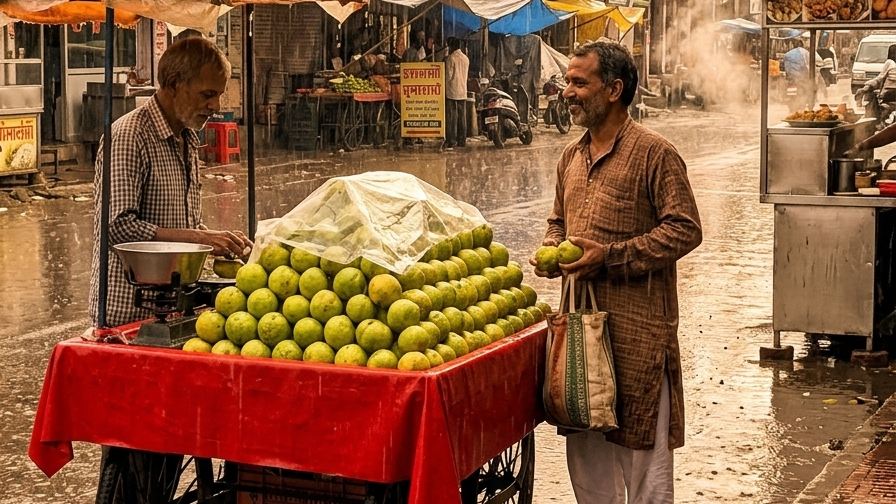
Every year, the moment guavas start appearing in the market, my heart does this little skip. It pulls me right back in time when my father would buy them home, always from the first slot.
It’s been years since he left us .
But he never really left.
He’s with us in every story, every memory.
Especially in Guava Season.
Well, the guava thing – No one asks him to bring them,
No one reminds him.
He doesn’t like them. But –
He just remembers to buy them from the first slot itself.
U know why –
Because I like them too much.
I never knew when he noticed it.
As a kid, I thought it was just fruit.
Now I know it wasn’t a fruit only.
It was his way of showing love and care.
……………………. (Sigh)
I know,
I was not a good daughter.
Not the way my sisters were.
I didn’t have that loud, clingy, always-hugging kind of bond with my father.
For the longest time, I thought it was because I was different.
Colder. Distant. Maybe even ungrateful.
But recently I realized something.
I’m not different.
I’m exactly like him.
Because Just as like my father –
I trust people easily.
I don’t over-argue. I don’t overthink before taking action.
I take responsibility for what I do.
I help people to the best of my abilities.
I try to fulfill everyone’s wishes, even small ones.
Money is just money to me. It’s never been the center of my world.
But I also get hurt easily,
Because every small detail matters to me, which most people didn’t even notice.
As I don’t forget how you behaved to me.
And just because I talk politely doesn’t mean I’ve forgotten what you did to me.
I notice how you treated me when I was of your use and when I was not
I watch your tone while talking to you.
I never see you differently because of your social status.
I never talk badly about anyone.
I know the truth, but I still enjoy people’s performances.
I’m not bad at heart.
And I’m not at tongue either… until you provoke me.
And once you do, I’m not responsible for my actions.
In short — I’m a silent giver. Just like my father.
And maybe that’s why I failed as a daughter.
Because being like him also meant I never learned how to say it out loud.
We show love by doing, not by speaking.
Now when guava season comes, I buy them myself.
I pick the first ones from thela.
And while paying, I finally understand.
It was never about the guava.
It was about showing up. Quietly. Consistently. Without needing credit.
I may have failed to say it, but I hope he knows – I turned out just like him. I am Very Proud of it.
But when you’re actually living it… nothing feels obvious at all.
I thought I had a script in my head. Do this, get that. Say this, feel that.
But no one told me about the nights where you lie next to someone and still feel alone. No one told me about the small fights that aren’t about the fight at all. No one told me that love isn’t a destination you reach after the wedding. It’s a road you choose every single day.
The truth is, I’m still unlearning a lot. Unlearning the idea that asking for space means I don’t care. Unlearning that keeping quiet is the same as keeping peace. Unlearning that I have to have it all figured out just because I’m an adult now.
That’s why I’m writing.
Not as an expert. Not with answers.
Just as The Girl Behind The Grid.
The one who’s figuring it out in real time.
The one who’s tired of pretending everything is “obvious”. And if you’ve ever wondered the same things at 2AM…
If you’ve ever goggled “is this normal?”
You’re not alone here.
Welcome. Let’s figure it out together.
On June 1, 2025, I got married. I’ve always believed that marriage is proof of love. It’s clear that we should love our spouse, no matter what challenges lie ahead. But everything is very different. It’s not bad—just unlike what I imagined. We have different choices, thoughts, habits, and likely views on life.
The not so Obvious days 01
I am the kind of person who says, “just ignore the evil and let God handle it”
He believes, “God can’t be everywhere, so he gave you the strength to go and turn the tables.”
In the beginning i thought this is normal as i have heard “Opposites Attract”
But frankly, that is not the case at all.
The not so obvious days 02
One of us lives with a suitcase half-packed.
The other lives half-wrapped in a blanket.
I’m the one making Pinterest boards at 2AM.
“Goa?” “Himachal?” “Kerala backwaters?”
He’s the one saying, “But the bed is so good here.”
It’s not that he doesn’t love me.
He just loves comfort more.
And I don’t hate home.
I just hate the idea of missing the world while we’re still young.
The not so Obvious days 03
One day I had a fight at work, and it was probably his first day there. I was actually so angry at the behavior of someone that I couldn’t help shouting out “ get out of my office right now”. I pulled my chair over and sat down. He sat next to me, relaxed, which irritated me more. I expected him to say something. I looked at him, wide-eyed.
That night,I tried asking him for an answer,
All he replied – “just sleep , we will discuss it tomorrow , okay .
I didn’t sleep that night and woke him up at 4:00 am sharp. I know I’m being a lot, but sorry ..
He rubbing his eyes, and laughing out loud, said:
“Listen, girl, I know you don’t need me to handle such small situations, and if the matter worsened i was standing at the back i won’t ever let you fall. “
After listening to his reply, all the arguments I had framed all night to pick a fight with him were in vain.
I slowly realize that in this short time:
Love isn’t about wanting the same things. It’s about accepting the difference and embracing them. It’s about learning to carry each other’s bags. It’s about supporting each other in tough times. But it’s also about giving the freedom and confidence to manage things independently. And here is the crack I got. I realised that we fight, we bargain, we compromise.
We think love continues after “I do” but the truth is, “I do “ is just day 1. Every other day, you still have to choose it. Love is all about putting efforts to understand each other. Efforts that are not about words only, efforts that show up in actions. And that’s what makes the life keep going.
So no, it’s not obvious.
It’s intentional.
It’s not happy ever after.
Its Efforts Ever After.
And maybe that’s what makes it beautiful.”
The Girl Behind The Grid
“Tell me — what’s something that wasn’t ‘obvious’ to you? I’m reading every comment.